Bedtime Reading
Four papers were published recently. I think you’ll find them to be interesting and illuminating.
The first and most comprehensive is “Physicians and Their Practices Under Health Care Reform: A Report to the President and the Congress.” This 50 page report, authored by a diverse group of academics with support from The Physicians Foundation, is intended to add depth to the discussions of health care reform. It focuses particularly on problem of deepening physician shortages, the needs of physicians’ practices in a reformed health care system and the effects of poverty and other social determinants on health care utilization and outcomes. Its conclusions are that, without adequate numbers of physicians, the health care system cannot function; without adequate attention to the organization of physician practices, the system cannot function efficiently; and without adequate attention to the pervasive effects of poverty and other social determinants, it cannot function economically. It poses important challenges to health care reform, as it is now being formulated.
For those looking for a quick read, a newly-published JAMA Commentary, entitled “Regional Variation and the Affluence-Poverty Nexus,” is made to order. In only two pages, it picks up on one of the critical questions examined in the Report: “What explains the ‘unexplained’ variation that? The answer lies in economic and social dynamics that operate separately at the communal and individual levels and that influence the use of health care resources and the outcomes they produce. Simply stated, wealthier communities have more resources, use more health care, and achieve better average outcomes—the vectors are linear and direct. Conversely, low-income individuals use the most health care resources, and those who use the most tend to have the worst outcomes—the vectors are nonlinear and principally inverse.” It concludes that, “as the United States confronts difficult fiscal choices, there should be no illusion about the relationship among physician supply, health care spending, and outcomes. Nor should there be uncertainty about how poverty affects health care utilization. The reality is that more is more and that poverty leads to less, and the false assertion that ‘more is less’ should not detract from efforts to ensure that the United States will have an adequate supply of physicians for the future.”
The themes of the Report are also addressed in a short piece that Arthur Rubenstein (Penn’s dean) and I published this week as [part of the American Academy of Arts and Sciences new online dialogue, Aspects of the Health Care Crisis. It’s entitled “The Three “Ps” Of Health Care Reform: Pay-For-Value, Primary Care, And Poverty.” We conclude that “the strategies proposed for pay-for-value will fail to add value, just as proposed strategies for more PCPs will fail to provide more primary care, and the absence of a comprehensive approach to poverty leaves a gaping hole. Approaching these issues with clarity and vigor would lead to better access, broader equity, greater physician autonomy, and more cost-effective health care. That would be real reform.”
The week ended with an op-ed piece in the Washington Post on Friday (September 11), entitled “Wrong Map for Health Reform.” It concludes that, “to really achieve health-care reform, and find a way to pay for it, the President will have to give up on the Dartmouth suggestion (that 30% can be saved by getting everyone to look like the Mayo Clinic) and grapple with some painful truths. First, medical care is inherently variable in different regions of the country — socio-demographic differences matter. Second, more is more and less yields less — the best care is the most comprehensive care, and it costs more. Finally, poverty is expensive — the greatest “waste” is the necessary use of added resources when coping with patients who are poor. If we want a technologically advanced, socially equitable health-care system, we will have to organize our finances accordingly. There is no quick fix. That’s what we should be talking about.”
********************************************************************
Taken together, these are a call for reform, but not reform as it’s being played on the political field, nor reform dissociated from reality, but honest reform that recognizes the underlying dynamics and is willing to address the tough priorities. For, as the Washington Post op-ed concluded, “if we want a technologically advanced, socially equitable health-care system, we will have to organize our finances accordingly. There is no quick fix. That’s what we should be talking about.”
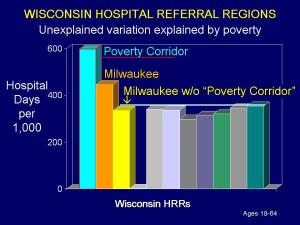
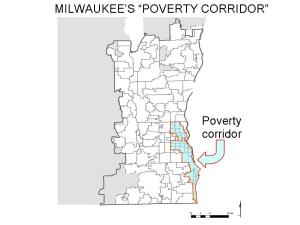 The answer is that it’s a complex urban environment, not as complex as Chicago or Los Angeles, but complex enough. It also turns out that Milwaukee is profoundly segregated. That allowed us to carve out what we termed the “poverty corridor,” where more than 90% of blacks and 75% of Latinos live and where poverty abounds. Hospital admission rates in the “corridor” were 66% higher than in the rest of Milwaukee, and they accounted for the entire difference. The Milwaukee region without its poverty corridor is like the rest of the state. Move the corridor to Green Bay, and Green Bay’s health care would resemble Newark’s.
  This should be familiar to the President. Milwaukee’s poverty corridor is like Chicago’s 17th and 20th wards, where the President worked. He knows about poverty. So let’s stop the Dartmouth doubletalk and start addressing the root cause of variation in spending -– p-o-v-e-r-t-y.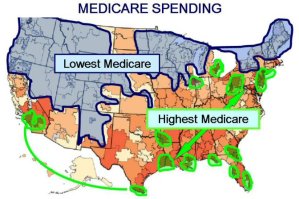
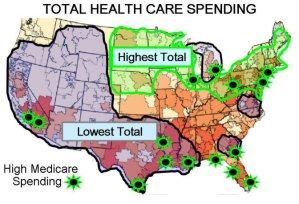 QUINTILES ARE NOT RANDOM.
 Buz Cooper MD