Category: Uncategorized
To: The Senate Finance Committee from an Economist and a Doctor (abbreviated)
We wish to comment on the Committee’s statement that studies of geographic variation consistently show that 30% of Medicare spending is wasted, and on the Committee’s conclusion that policies requiring spending reductions by physicians whose spending is above a certain threshold may be useful.
While the studies cited are consistent, so too are their methodological shortcomings. In particular, Medicare spending cannot serve as a proxy for real resources inputs (labor and capital) (see Mississippi, Alabama and Nevada). When total health care spending is assessed, instead, higher resource inputs are generally associated with better quality, even recognizing that the highest resource use is by patients who are sickest and whose outcomes are the poorest.
The notion of “30% waste” has deeper roots in an invalid thread of logic that begins by characterizing regional differences in Medicare spending as “unexplained,” and because differences are “unexplained,” they must be unwarranted, and because they are unwarranted, they must be wasted. Logic dictates that, when differences are unexplained, explanations must be sought. In fact, when that has occurred, variation has been attribltable to differences in the prevalence of disease, patients’ risk factors, patients’ income, community characteristics and even altitude. Moreover, these pervasive and stubborn variations have been found in other developed countries, where health care financing and delivery systems are very different from the US.
The belief that broad-scale geographic variation in Medicare spending can offer a path to short-run savings is incorrect. It should not form the basis for incentives or penalties affecting physicians’ practices. Indeed, restrictive policies, including those under consideration, could deprive some patients of beneficial care.
Richard A. Cooper, MD, Professor of Medicine Mark Pauly, PhD, Bendheim Professor of Health Care Management and Economics University of Pennsylvania
The Geography of Knee Replacements
In a recent WSJ op-ed, Peter Orszag once again called for the elimination of “unexplained variation” as a means of decreasing health care spending. This time he zeroed in on Milwaukee, which I actually know something about, having not only grown up there but returned to many tears later as dean of the medical school. Orszag cited the fact that knee replacements are much more frequent in Milwaukee than in Manhattan, and he’s right. But a close look at the data (see the accompanying map) shows that Milwaukee’s greater use of knee replacements is not because nefarious doctors are bilking the system and that 30% of health care spending could be saved by stopping such waste, as Orszag would have us believe. 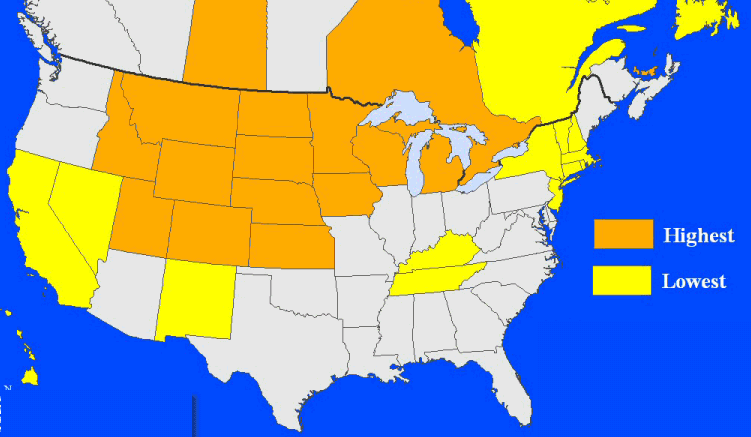 The reason is that Milwaukee is within a cluster of states with high rates. They extend from Idaho to Michigan and from Kansas to North Dakota, but they don’t stop there. High rates continue into Saskatchewan, which sits atop North Dakota and has the same high rates, and into Ontario, which sits above Michigan and shares Michigan’s high rates. Knee replacement rates in these states and provinces average 70% higher than in regions with the lowest rates, which are in three clusters: California/Nevada/New Mexico + Hawaii; Kentucky/Tennessee; and New York/New Jersey/New England, and these low rates extend straight up from New England in to Quebec, Newfoundland and Labrador. The rates are as different in Quebec and Saskatchewan as they are in Massachusetts and Montana. How interesting that two neighboring countries with two different health care systems have identical patterns of geographic variation — a phenomenon that knows no borders. (Note that because the rates are lower among blacks, the map only shows rates for whites. These data are available from the CDC and the Canadian Institute of Health Information.)
Although it is difficult to explain this phenomenon, variation in knee replacements doesn’t appear to reflect some wasteful practice patterns. Rather, it’s more likely related to some cultural of environmental factors that span the US and Canada. From a health policy perspective, this is yet one more example of the fact that “unexplained variation” can usually be explained, and the explanations are usually related to the nature of the patients and their diseases and not to the practices of the physician who are caring for them. But where did this misunderstanding of knee surgery come from? Straight from the Dartmouth group. Here’s what John Wennberg (group leader) had to say about the wide geographic variation in knee replacement surgery and its persistence of over time: “What mattered most in predicting the rates in 2000–01 was the rates in 1992–93. In other words, the “surgical signatures” of regions are remarkably stable over time. Left alone, practice variations do not go away. Intervention is needed at the level of the doctor-patient relationship to reduce the role of medical opinion and enhance the role of the patient in choice of treatments.” Why “surgical signatures” rather than the usual “supplier-sensitive services”? Because there’s no correlation between knee surgery and the supply of surgeons, so it’s just that surgeons remember to do too many! Surely someone at Dartmouth must have noticed that the high and persistent rates were all in the plains and upper-Midwest, where Medicare spending is lowest, and it must have occurred to someone to ask if the durability of these rates was related to some durable characteristic of the population rather than to persistently wasteful physicians.
In his column in the NYT the same day as Orszag’s op-ed piece, David Brooks reminded us that health care has become “the bank” out of which President Obama plans to fund the bulk of his agenda. “By squeezing inefficiencies out of the health care system, he could have his New New Deal and also restore the nation to long-term fiscal balance.” The inefficiencies that the President talks about are Orszag’s 30% solution – which is based on getting rid of regional variation in physician practices, like knee replacements in Milwaukee. But durable solutions to health care reform will rest on critical analyses of health care data and reasonable expectations of what can be saved through system modifications. The current misperceptions and exaggerations by OMB are jeopardizing that goal.
Straight Talk for a Straight-Talking President
In his interview in Sunday’s Times Magazine, President Obama was quick to point out that “most doctors want to do right by their patients.” But he went on to say, “so if it turns out that doctors in Florida are spending 25 percent more on treating their patients as doctors in Minnesota, and the doctors in Minnesota are getting outcomes that are just as good — then us going down to Florida and pointing out that this is how folks in Minnesota are doing it and they seem to be getting pretty good outcomes, and are there particular reasons why you’re doing what you’re doing? — I think that conversation will ultimately yield some significant savings.” And that’s straight from the Dartmouth playbook, which is never straight. So let’s take a look at what’s really going on.
Yes, President Obama is right. Adjusted for price, Medicare expenditures per enrollee are 25% higher in Florida than Minnesota. And, as measured by various quality standards, Florida ranks lower. But the quality standards used reflect health care throughout the community, not just among Medicare patients – indeed mammography screening rates are lower in Florida in both the Medicare age group and among younger women. Such outcomes depend on inputs from all sources, not just Medicare. So how do Minnesota and Florida stack up? Minnesota spends more per capita, not less – 13% more. It’s not a low-cost haven. Minnesota has lower Medicare expenditures but, with fewer uninsured, good benefits plans and generous Medicaid, it spends more overall – and it gets more!
If the President visits Miami and Minneapolis, he’s likely to find out something else – something that he’s had lots of experience with in Chicago. He’ll find poverty in Miami, especially in the Medicare age group. Almost 30% of Miami’s seniors are below the poverty line, triple the rate in Minneapolis. When the distribution of household income is examined, Miami resembles Chicago’s 17th and 20th Wards – familiar turf for the President – a preponderance of poor households. And we know that folks in the lowest range of household income use twice the health care resources as those in the top, or even middle (see “Lets Talk About Poverty“).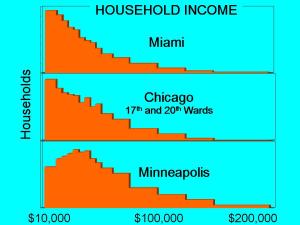 Although the Dartmouth folks grumble that “single working mothers in Nebraska are footing the bill for gold-plated health care provided to high-income Medicare enrollees in Miami,” it’s Miami’s poor who use the most. So, the message is that poverty is expensive to the health care system, including to Medicare , and like Chicago’s south side, south-Florida has lots of it, while Minneapolis has very little. Miami’s poorer outcomes reflect its burden of poverty and Florida’s overall under-investment in health care. Yes, Mr. Obama is right. A straight-talking conversation will ultimately yield significant insight about spending. The title of that conversation may surprise some, but it won’t surprise the President – it’s POVERTY.
How is the US Doing?
A well-known health policy leader asked if wasn’t true that our country has a higher rate of preventable mortality than any other of the OECD countries, as the Commonwealth Fund has demonstrated. My answer was, it depends on which of our countries he is talking about. We have many. The map below shows just two – the Confederacy and the rest. Except for the Confederate states, the United States is rather average among OECD countries, with preventable mortality most similar to Finland. But the Confederate states are the worst in the world, with a preventable mortality rate double that of France. 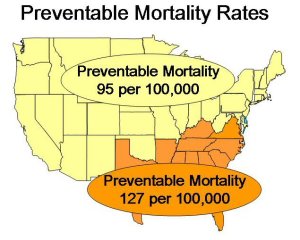
Much of this can be traced to higher mortality among blacks, who account for 20% of the population in the old Confederacy, but only 10% elsewhere. Across all states, preventable mortality correlates strongly with percent of the population that is black (correlation coefficient = 0.8). But there are sharp north-south differences even among blacks. Black mortality in the Confederacy is 55% higher than in the rest of the country, and white mortality is 15% higher.
So we should not be too quick to malign the US health care system for spending too much and having poor outcomes. We are a nation of nations and must be understood in those terms. And the effects of race and poverty must be understood in each of these “nations.” Real health care reform will have to be built around regional realities and about the realities of wealth and poverty in each.
Let’s End the Primary Care-Specialty Schism and Solve the Physician Shortage – A Short Essay
In his new book about Lincoln as a writer, Fred Kaplan describes Lincoln’s disdain for the “linguistic dishonesty” of leaders of the Confederacy, who attempted to divide the nation with “a barrage of verbal propaganda that corrupted the relationship between language and truth.” Strong words, but not unlike the verbal propaganda that has been used to create a schism between primary care physicians and specialists and that is impeding solutions to the nation’s physician shortage.
We are told that patients in areas with more primary care physicians and fewer specialists spend less on health care but receive better quality care, use fewer hospital and outpatient services, incur lower end-of-life expenditures and achieve better health status. They even have lower mortality from cancer, heart disease and stroke, decreased infant and maternal mortality, decreased all-cause mortality and increased life spans. All quite remarkable. And while one can find a kernel of “statistical truth” in some of these studies, it generally disappears once race and poverty are considered. And when these are considered, the associations apply to family physicians but not general internists or pediatricians, who practice in the same manner, a curious anomaly that results from the preference for family practice in states along the northern tier. Indeed, the superior outcomes have everything to do with the merits of Minnesota over Mississippi and nothing to do with the merits of primary care. 
But what about the old saw that primary care physicians can deliver specialty care better and cheaper than specialists? Greenfield, who led these studies in the 1990s, acknowledges that they lacked adequate risk adjustment, and subsequent studies have shown that specialty care generally yields better outcomes, particularly for patients at greater risk, although with greater costs. But these conclusions run headlong into the Dartmouth’s Atlas, where outcomes in “regions” with more specialists and more spending are said to be no better and sometimes worse. Yet even a casual inspection of the Dartmouth map shows that the “region” with the most spending is a scattered collection of America’s densest urban centers, while the “region” with the least encompasses the vast northern tier, from Alaska to Maine (see “The 30% Solution”). Yet these two vastly dissimilar areas have equivalent outcomes.
Even more curious are the statistical gyrations used by members of the Dartmouth group in claiming that “states where more physicians are general practitioners have higher-quality care and lower costs, whereas states where more physicians are specialists have lower-quality care and higher costs.” While widely cited, these claims are simply false (see “Less is Less-Mississippi” March 26th). States with more specialists actually have higher quality care. Mississippi and Nevada, where quality is low, do not have an abundance of specialists, as portrayed, but the fewest in the nation.
Take note. Obama has arrived from the land of Lincoln with the clear message that language and truth must be reunited. And Lincoln would probably add something about what happens when a profession is divided against itself. Primary care physicians don’t need to be advertised as better “specialists” than specialists, nor as the fountain of long life, and falsely denigrating specialty care doesn’t make primary care physicians more valuable. Patients know their value already. And experts know that health care is better when primary care physicians and specialists work together and best when there are more of both. The tasks at hand are to end the “verbal propaganda” that divides disciplines and concentrate on expanding physicians supply overall so that future generations will have access to the technologically advanced, socially equitable care that they will want and deserve.
For references, contact cooperra@wharton.upenn.edu
No One Home in the Medical Home
I had the pleasure of participating in the American College of Physician’s International Forum. The question posed to the Forum was, “what is the future of Internal Medicine?” Physicians from other nations described the more traditional roles of Internists as consultants to primary care providers and physicians for patients with multiple co-morbidities. But the ACP sees Internists as custodians of the “Medical Home,” a broad and inclusive model of care that is more conceptual than practical and only minimally tested among adult populations. Yet even if it proves to be valid, it faces the reality that there won’t be enough Internists, or Family Physicians, to make it happen.
This lack isn’t simply because Internists and FPs aren’t paid enough, although they aren’t. It’s because there won’t be enough physicians overall. There already are too few general surgeons and too few urologists, and the oncologists project a 40% shortfall within ten years. Faced with shortages like these, physicians will have to gravitate to roles that only physicians can play, while most of what goes on in a Medical Home is undertaken by Nurse Practitioners and others.
But the problem for Internists goes even deeper. With the demand for hospitalists and internal medicine subspecialists growing steadily, it is unlikely that there will be enough Internists even for the absolutely essential roles of serving as consultants and providing care to patients with multiple infirmities. The reason is unambiguous. Too few doctors are being trained, and that is because Medicare capped its support for residency training in 1996, while population and the economy have continued to grow.
Some see this as good – it’s a form or rationing. But it’s not good. America will never ration care for profoundly ill patients. And, sadly, the creation of physician shortages assures that there will be many more patients who present with late disease, simply because access to earlier care was not available.
So the message to the ACP is that it will not be possible to build a bigger workforce of Internists unless the entire physician workforce is expanded, and the physician-directed Medical Home will remain a distant dream.
Obama’s War On Poverty – Say It Isn’t So
Can it be true that the way we’re going to reform health care is to:
(1) Cut hospital reimbursement for readmissions (principally of poor people).
(2) Penalize hospitals and physicians who provide more services (principally to poor patients).
(3) Cut Disproportionate Share (DSH) payments to hospitals (which are for disproportionate numbers of poor patients)
(4) Reduce the amount of subsidies for low-income individuals to buy insurance.
Say it isn’t so.
Let’s Talk About Poverty
Did you know that the poorest 15% of our fellow citizens consume more than twice as much health care as the richest? That means that if health care spending for everyone could be the same as it is for individuals at the median, our nation would consume 20% less health care. That’s a sobering reality.
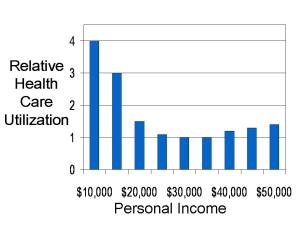
These extra costs are partially due to more emergency room visits, but they are mainly due to more doctor visits and more hospital admissions and more readmissions and longer lengths of stay and more in-hospital deaths, because poverty and illness go hand in hand, and outcomes are poor among the poorest, and coping with illness is far more difficult when you’re poor, especially if you lack a support system and education and language proficiency.
Poverty actually accounts for most of the regional differences in health care spending that have captured the attention of policy-makers and that I have commented upon elsewhere in this Blog. But the connection between regional variation and poverty is rarely made.
Solving this problem will not be easy. Part of the solution is in wider use of tools that are known to decrease these costs among poor individuals, such as interpreters and home health aids and other strategies that strengthen the local infrastructure that enables health care. Of course, durable solutions require attention to the underlying disease – poverty – and that’s the biggest challenge. But the stakes are high and the value is broad, not only for health care but for the lives of those who will otherwise be poor. Dealing with the high health care costs of poverty should be the top priority of 21st Century health care reform.
It’s the Altitude, Stupid!
What good fortune I had to encounter Chris Hogan, a creative and insightful health policy consultant. He was asked to figure out why home oxygen therapy costs Medicare 6-fold more in some states than in others. The highest costs were in Wyoming, Colorado, Utah, Nevada and New Mexico, while Hawaii, Minnesota, North Dakota, Maryland and Rhode Island had the lowest.
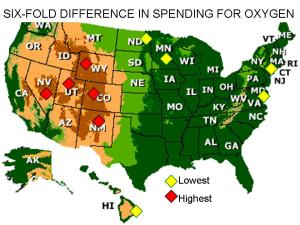
Some of this had to do with differences in the prevalence of chronic obstructive pulmonary disease (COPD), but the correlation was weak. Then Hogan looked at a topographical map of the US, and it all made sense. Spending was high at high altitude and low at sea level. When both the prevalence of COPD and altitude were considered, the correlation was 0.93 (almost a perfect 1.00).
Explaining regional variation is important. It guides coherent health policy. But coherent policy doesn’t come from assuming that variation is “unexplained” and therefore due to specialists (or medical equipment companies), which is what the Dartmouth group preaches. And that’s led to strategies from the Office of Management and Budget (OMB) to decrease spending in high spending areas by reining in specialists. Maybe there are clinical reasons for that spending. Whenever anyone has looked closely, they’ve been found.
A Tale of Two Cities: Birmingham and Grand Junction
The quiet of an Easter evening was shattered by a phone call from an irate surgeon saying, “did you see Peter Orszag’s Congressional testimony last year and the one by Elmendorf (his acting replacement at the Congressional Budget Office-CBO) last month?” Yes, I had seen both – they’re fundamentally the same. Both cite a 2002 paper from the Dartmouth group claiming that less than 30% of the variation in health care spending among regions is accounted for by differences in illness rates, and differences in income explain little more.
Their “poster child” for this statement is a study comparing Grand Junction, Colorado, one of the healthiest regions, and Birmingham, Alabama, one of the least healthy. By the Dartmouth group’s measure, the prevalence of heart disease, stroke and a number of other major illnesses is 55% higher in Birmingham than Grand Junction (although heart disease and stroke rates are actually double). And hospital and ICU days were right in line with this increased burden of illness: 48% more days and 38% more ICU days, so it’s not clear what the problem is. It looks as though disease burden more than explains the variation.
But there are a few other rather important differences between Birmingham and Grand Junction. Birmingham’s poverty rate is 25%, which is more than double that of Grand Junction, and 76% of Birmingham’s population is black, compared to 0.6% in Grand Junction. And contrary to the CBO’s testimony that “income explain little,” income explains everything. Individuals in the lowest 15% of income utilize twice as much health care as those with higher income.
In fact, if Alabama had the resources to provide all of the needed care to its citizens, utilization should not simply have been 38-48% greater in Birmingham, in line with its higher illness levels. It should have been 100% more, based on the combination of illness levels and poverty. And that’s exactly what is seen in northern communities, where poor populations with high burdens of disease inhabit urban ghettoes. But, unlike the circumstance in Alabama, these patients have access to facilities and resources that are established by the greater affluence of northerncommunities, and it is reflected in spending.
The lesson is that illness maters. And poverty matters. And whether or not zones of poverty are embedded in regions of affluence matters. And together these factors explain most of the regional variation that the Dartmouth group and the CBO seem to have so much difficulty explaining. Which would not be a problem except for the fact that they are converting confusion over regional variation into confused health policy.
 Buz Cooper MD