Category: Uncategorized
Bedtime Reading
Four papers were published recently. I think you’ll find them to be interesting and illuminating.
The first and most comprehensive is “Physicians and Their Practices Under Health Care Reform: A Report to the President and the Congress.” This 50 page report, authored by a diverse group of academics with support from The Physicians Foundation, is intended to add depth to the discussions of health care reform. It focuses particularly on problem of deepening physician shortages, the needs of physicians’ practices in a reformed health care system and the effects of poverty and other social determinants on health care utilization and outcomes. Its conclusions are that, without adequate numbers of physicians, the health care system cannot function; without adequate attention to the organization of physician practices, the system cannot function efficiently; and without adequate attention to the pervasive effects of poverty and other social determinants, it cannot function economically. It poses important challenges to health care reform, as it is now being formulated.
For those looking for a quick read, a newly-published JAMA Commentary, entitled “Regional Variation and the Affluence-Poverty Nexus,” is made to order. In only two pages, it picks up on one of the critical questions examined in the Report: “What explains the ‘unexplained’ variation that? The answer lies in economic and social dynamics that operate separately at the communal and individual levels and that influence the use of health care resources and the outcomes they produce. Simply stated, wealthier communities have more resources, use more health care, and achieve better average outcomes—the vectors are linear and direct. Conversely, low-income individuals use the most health care resources, and those who use the most tend to have the worst outcomes—the vectors are nonlinear and principally inverse.” It concludes that, “as the United States confronts difficult fiscal choices, there should be no illusion about the relationship among physician supply, health care spending, and outcomes. Nor should there be uncertainty about how poverty affects health care utilization. The reality is that more is more and that poverty leads to less, and the false assertion that ‘more is less’ should not detract from efforts to ensure that the United States will have an adequate supply of physicians for the future.”
The themes of the Report are also addressed in a short piece that Arthur Rubenstein (Penn’s dean) and I published this week as [part of the American Academy of Arts and Sciences new online dialogue, Aspects of the Health Care Crisis. It’s entitled “The Three “Ps” Of Health Care Reform: Pay-For-Value, Primary Care, And Poverty.” We conclude that “the strategies proposed for pay-for-value will fail to add value, just as proposed strategies for more PCPs will fail to provide more primary care, and the absence of a comprehensive approach to poverty leaves a gaping hole. Approaching these issues with clarity and vigor would lead to better access, broader equity, greater physician autonomy, and more cost-effective health care. That would be real reform.”
The week ended with an op-ed piece in the Washington Post on Friday (September 11), entitled “Wrong Map for Health Reform.” It concludes that, “to really achieve health-care reform, and find a way to pay for it, the President will have to give up on the Dartmouth suggestion (that 30% can be saved by getting everyone to look like the Mayo Clinic) and grapple with some painful truths. First, medical care is inherently variable in different regions of the country — socio-demographic differences matter. Second, more is more and less yields less — the best care is the most comprehensive care, and it costs more. Finally, poverty is expensive — the greatest “waste” is the necessary use of added resources when coping with patients who are poor. If we want a technologically advanced, socially equitable health-care system, we will have to organize our finances accordingly. There is no quick fix. That’s what we should be talking about.”
********************************************************************
Taken together, these are a call for reform, but not reform as it’s being played on the political field, nor reform dissociated from reality, but honest reform that recognizes the underlying dynamics and is willing to address the tough priorities. For, as the Washington Post op-ed concluded, “if we want a technologically advanced, socially equitable health-care system, we will have to organize our finances accordingly. There is no quick fix. That’s what we should be talking about.”
The Dartmouth Atlas is a Road Map to Nowhere
In their continuing quest to convince politicians that health care reform can be financed by greater “efficiency,” Dartmouth Atlas leader Elliott Fisher and a small band of sympathizers cited ten “model regions” in their recent New York Times op-ed (August 13). By their description, they include “towns big and small, urban and rural, North and South, East and West.” Here’s their list: Asheville NC, Cedar Rapids IA, Everett WA, La Crosse WI, Portland ME, Richmond VA, Sacramento CA, Sayre PA, Temple TX and Tallahassee FL. Big? Well Sacramento has more than 400,000 souls, but it’s the largest, and none of the others reaches 200,000. Small? Well, yes. Sayre weighs in at 5,400. The average of all ten is 131,000. Are these representative of America? Hardly. No more than Grand Junction CO (population 50,000), where the President sojourned this weekend to teach us how medicine should be practiced. Even if Medicare was a valid metric, can we design health care reform based on health care spending in these communities? You’re kidding! The major challenges are in the big urban centers, where affluence and poverty intersect, and in the old Confederacy, with its broad swath of poverty and accompanying poor outcomes that put the US at the bottom of the pack internationally.
The Dartmouth Atlas has led policy-makers to believe that future expenditures can be off-set by small town efficiency. Their route to efficiency is through “pay-for-value,” which would reimburse doctors and hospitals more if they spent less but had good outcomes, like in small towns. On the surface, this makes sense. We’ll pay more for cars that run better. But patients aren’t cars, and south Los Angeles is not Grand Junction, and Medicare spending is not even a valid measure of value. The worst outcomes are among patients who are sickest and need the most, and they cost the most, and disproportionate numbers of them are poor. Pay-for-value would cut reimbursement to hospitals that readmit more patients, most of whom are poor, and penalize physicians who provide more services to patients, most of whom are also poor. If America truly wants health care reform, it will need a new map, one that can distinguish the eastern megopolis from open plains and the poverty belt from the rust belt. The Dartmouth Atlas is a map to nowhere.
What If The Problem Is Poverty?
The Institute of Medicine (IOM) has addressed seven key health care reform questions and offered answers that capture today’s consensus. No surprises, but good clear analyses. But what if the underlying conceptual framework is not an excessive use of services by wrongly incentivized providers but the tragic over-use of services by the poor? Here are seven “what ifs” plus an eighth question.
1. Is health care too expensive?
What if health care is the economy, the major source of jobs and the basis for America’s worker productivity? And what if the problem is an unfair insurance system and inequitable distribution of fiscal responsibility?
2. How much too expensive is it?
What if regional variation is not a manifestation of excessive spending but of income inequality and the intersection of wealth and poverty? And what if differences in price and economic development, rather than waste and inefficiency, differentiate costs among countries?
3. Where’s the excess?
What if the major excesses are not unwarranted services, fragmented delivery, administrative costs, malpractice expenses and myriad others, all of which contribute, but the costly and inefficient delivery of services to the nation’s poorest?
4. What’s driving the growth?
What if growth of health care is a necessary constituent of a technologically-advanced nation and factors such as aging and life-style simply define major targets of that growth?
5. What are the key levers for change?
What if professional regulation and practice incentives are the problem and not the solution? And what if professional autonomy is the friend of quality?
6. Which initiatives can make a difference?
What if pay-for-value, specification of services and national guidelines distort the clinical process, increase overall costs and impair aggregate outcomes?
7. How much difference?
What if more than 10% could be saved if costs for the poorest 25% of the population were the same as for the other 75%?
8. Why does the word “poverty” not appear in the IOM’s list of seven (or anywhere else)?
Obama’s Lament – Homage to Dartmouth
It’s tonsils that vary, but just on the right. The left one stays in – it’s always in sight.
The right one goes fast, ’cause the profits are higher. Those damn greedy doctors, they lie, yes they’re liars.
They tell you that right one, must go down the drain. But it’s money they’re after, not less patient’s pain.
So health care reform’s in a terrible mess. It’s more tonsils and deficits, unless doctors do less.
Similarly Dead, Not Similarly Ill – Quintessential Dartmouth Doubletalk
The Dartmouth Atlas Frequently Asked Questions section asks: “How do you ensure some patients were not more severely ill than others?” Here’s the Dartmouth answer: “The study only focused on patients who died so we could be sure that patients were similarly ill across hospitals. By definition, the prognosis of all the patients in the cohort was identical – all were dead after the interval of observation. Therefore, variations cannot be explained by differences in the severity of individuals’ illnesses.”
So, let’s see. A hospital where a senior gets minimal care after an acute MI and dies in 36 hours is efficient, but a hospital where his identical twin got a full range of care and survived, only to die of a second MI on the golf course six months later is inefficient. OK, I get it. Similarly dead. Even similarly ill, at the start. But where would you go for care? And who would ever judge “efficiency” this way?
Dartmouth Strikes Again (at Poor People)
The “Dartmouth Honorary Clause” (Section 1123) of the House of Representatives discussion bill provides an incentive payment of 5% for suppliers of medical services in the 20% of counties that have the lowest Medicare expenditures. Are these counties distinctive in any other way? Well, yes. While they spend 40% less per enrollee on Part A services and 25% less on Part B than the highest-cost 20%, they have smaller populations (only ¼ as many Medicare enrollees as in the high-cost counties) and much less poverty (60% lower DSH payments per enrollee than in the high-cost counties). So there’s not much chance that the high-cost 20% will get that 5% boost. They just have the wrong demographics. Darn, all those poor people.
Gottcha on McAllen
This time they almost got me. I couldn’t really figure out why McAllen spends more than El Paso. But give me some credit. I figured out (1) why states with more specialists have poorer quality (they don’t; it’s phony statistics); and (2) why states with more Medicare spending have poorer quality (because many states with the most Medicare spending have low total spending, which is the determinant of quality); and (3) why nothing was necessarily better among the Medicare quintiles (because they were distributed randomly with respect to total spending); and (4) why there are more knee replacements in Minnesota than in Massachusetts (rather interesting because it’s backwards – Minnesota is supposed to be the land of sky-blue spending, but it’s in the bowl of high knee replacements) and (5) why health care outcomes in the US are the poorest in the world (because the Union won the Civil War and got the Confederacy, where health care spending is low and outcomes are poor); and (6) why women in Lewiston, Maine had more hysterectomies than women in nearby Wiscassett (because Lewiston is heavily Catholic, while Wiscassett is almost entirely Protestant, and the ladies of Lewiston used hysterectomies as a form of birth control that was acceptable to the Church.); and (7) why there are such great differences in resource use among academic health centers (because the ones with lowest use are in college towns, while the high-users are in major urban centers); and (8) why California’s academic medical centers differed so widely in resource use (because their patient populations had such different risk and income levels); and (9) why Medicare spending in Miami is not like Minneapolis (because Miami is as poor as the wards in Chicago where President Obama worked, and expenditures among the poor are vastly greater); and (10) why the use of oxygen equipment is higher in some states (because the higher use states are at higher altitudes, where folks with COPD need more oxygen); and (11) why Birmingham spends more than Grand Junction (because Birmingham has a 55% higher prevalence of major illness, double the poverty and 76% blacks, while Grand Junction has 0.6% – – in fact, Grand Junction is pretty much like Green Bay, the most recent poster child of efficiency); and (12) why mortality is lower in states with more family physicians (because they’re mostly in the upper Midwest, where there are fewer blacks, low poverty rates and longer life expectancy). But I couldn’t quite figure out (13) why McAllen spends more than El Paso, although others have made interesting suggestions. And then along came Dan Gilden, who showed that it’s simply a matter of disease burden. Sicker people use more care. So it’s 13 for 13 — not bad (with a little help).
About McAllen
Gawande’s New Yorker article has become required reading. But is McAllen a microcosm of American health care? Or is it a curiosity. I’m afraid it’s the latter. McAllen is unique. Read what McAllen’s physicians have to say about it. It’s at the most southern tip of Texas in a county with 725,000 people, 90% of whom are Hispanic – one of the poorest counties in the nation. But because of NAFTA, McAllen is the fastest growing community in the nation. People and money are pouring in from the north and across the border, and there’s also a great deal of cross border activity – working in one place, living in the other and shopping in McAllen on the way back. The in-pouring of wealth has fostered high-tech medical facilities – cancer centers, heart institutes, psych units, rehab units – big city medicine in the middle of nowhere. Entrepreneurism abounds, in retail, real estate and medical care. Yet 36% of the population is below the poverty line, including almost 25% of the Medicare population, whose outcomes are poor, not just in McAllen but everywhere. So, there a collision of abundant health care resources related to burgeoning wealth and massive utilization related to profound poverty — an extreme example of the affluence-poverty nexus. A Monty Python version US health care.
Possibly unaware of the connection, Gawande described the poverty effect in a previous New Yorker article, about the “Checklist.” That project took him to Detroit’s Sinal Grace Hospital, which the Dartmouth group had criticized as a hotbed of waste and inefficiency due to an overuse of supply-sensitive services. What Gawande stumbled into was quite different: “Occupying a campus of red brick buildings amid abandoned houses, check-cashing stores and wig shops on the city’s West Side, Sinai-Grace is a classic urban hospital. It has eight hundred physicians, seven hundred nurses and two thousand other medical personnel to care for a population with the lowest median income of any city in the country.” It is little wonder that its patients consume more resources, but such consumption is unlikely to result from “the overuse of supply-sensitive services.” Indeed, what the suppliers desire most is fewer demands on their already overworked lives. As in Chicago, poverty matters.
One last word, and it’s for the President. Health care reform is on a failure course because ideologues are twisting anecdotes into policy. I want you to succeed. I want the nation to succeed. Making McAllen required reading is not the way to do it.
On Wisconsin!
Wisconsin is in the press. Green Bay spends less than Los Angeles. Why does Wisconsin do so well? Yes, the folks are terrific. I was born and bred there and was dean of the Medical College of Wisconsin, so I know something about it, and I’m proud of Wisconsin. But I also studied it. Wisconsin does well in health care because of its favorable demographics and its prosperity. Few uninsured, good Medicaid coverage, excellent employer-sponsored insurance and moderate Medicare spending and low per capita spending overall, almost everywhere. But not in the Milwaukee region — spending is 30% greater than in the rest of the state. Why is that? 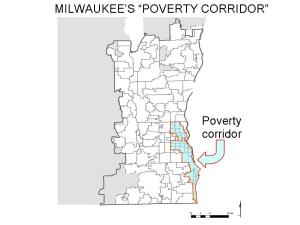 The answer is that it’s a complex urban environment, not as complex as Chicago or Los Angeles, but complex enough. It also turns out that Milwaukee is profoundly segregated. That allowed us to carve out what we termed the “poverty corridor,” where more than 90% of blacks and 75% of Latinos live and where poverty abounds. Hospital admission rates in the “corridor” were 66% higher than in the rest of Milwaukee, and they accounted for the entire difference. The Milwaukee region without its poverty corridor is like the rest of the state. Move the corridor to Green Bay, and Green Bay’s health care would resemble Newark’s.
 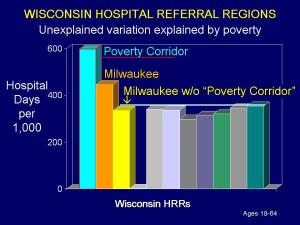 This should be familiar to the President. Milwaukee’s poverty corridor is like Chicago’s 17th and 20th wards, where the President worked. He knows about poverty. So let’s stop the Dartmouth doubletalk and start addressing the root cause of variation in spending -– p-o-v-e-r-t-y.
The 30% Solution – A Treacherous Prescription for Health Care Reform
According to a leader of Dartmouth’s Health Policy group, “if we sent 30% of the doctors in this country to Africa, we might raise the level of health on both continents.” Sadly, the notion that 30% of health care resources are wasted underlies much of the current thinking about health care and serves as a beacon for President Obama’s health care reform team. Where did it come from?
MEDICARE IS NOT A PROXY. The “30% solution” emerged from a Dartmouth study that divided the nation into five “Medicare-spending quintiles” and compared outcomes, such as access, satisfaction and mortality, among them. But these outcomes are not patient-specific, nor are they Medicare-specific. They reflect community-wide characteristics that depend on the total resources available from all payment sources, not just Medicare. Nonetheless, if Medicare is representative of the whole, as claimed, it would be a valid proxy. But it isn’t. As is apparent from the graphics below, Medicare spending bears no relationship to total spending per capita. But, as I’ve demonstrated, it is total spending per capita, not Medicare spending, that correlates with better outcomes, such as access, quality and the use of mammography. Thus, the fundamental basis used by the quintiles study to determine a community’s level of care – Medicare spending – is flawed. 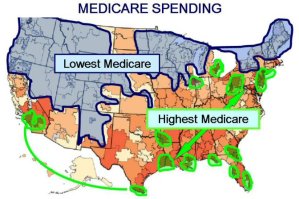
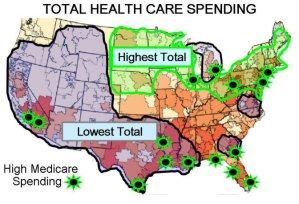 QUINTILES ARE NOT RANDOM. Assuming that Medicare is representative, a valid assessment of outcomes would require that all other characteristics that might affect outcomes would have to be the same. But even a casual inspection reveals how different they were. The highest-spending quintile was composed principally of dense urban centers, such as Chicago, Detroit, New York, Miami, Houston and Los Angeles, plus some smaller regions with extremes of affluence and poverty The lowest-spending one stretched across the northern tier, from Alaska through Washington and Oregon to Maine, and into the plains, half the land mass of America. Why possibly could be learned by comparing such dissimilar regions?
AGGREGATION AND AVERAGING MASKED DIFFERENCES. Despite these dissimilarities, the quintiles were all the same. How is that possible? The answer lies in the process of aggregation and averaging. Because each quintile contained hospital regions with a diversity of total health-care spending (despite similar Medicare spending) and a diversity of subpopulations, their averages were similar. The extremes of affluence and poverty and of high and low spending in the highest-Medicare spending quintile resembled the lowest, and like Lake Woebegone, everyone was above average.
STRINGING IT ALL TOGETHER. The Dartmouth group turned the fact that nothing was “necessarily better” into “it’s worse because it isn’t better.” Therefore greater levels of Medicare spending (despite the similar levels of total spending) must have been wasted. And because the differences in Medicare spending were “unexplained” (although they are readily explained), they must have been due to the overuse of “supply-sensitive services.” And these must have resulted from an over-supply of specialists. And, therefore, if the numbers of specialists were no greater in the high-spending than low-spending areas, the nation could save 30%.
And by stringing together these politically-charged phrases, the Dartmouth group succeeded in recruiting large numbers of believers — even an economist as brilliant as Peter Orszag, Director of OMB, asked, why can’t Newark be more like Minnesota?
But what the Dartmouth group really strung together were three profound errors: 1) Medicare is not a proxy for the whole; 2) the populations in each quintile were not random, and 3) aggregation and averaging masked real differences among population groups. Like Churchill’s Russia, the quintiles study was “a riddle wrapped in a mystery inside an enigma.” But the riddle has been solved. When critically examined, geographic variation in health care is seen to reflect the interplay between communal wealth and individual income. And the poignant reality that emerges is the powerful and tragic effects of poverty on health care utilization and outcomes (see “Let’s Talk About Poverty” April 23).
 Buz Cooper MD