
Category: Uncategorized
The MedPAC Squeeze: What’s at Stake for Rural America
Here’s what Tim Skinner, Executive Director of the National Rural Recruitment and Retention Network (3RNet), has to say about MedPAC, the agency that advises Congress on Medicare. MedPAC fully embraces the Dartmouth line that “more is less” (more physicians produce poorer quality), and it has failed to promote greater support for graduate medical education (residency programs), which is the only source of new physicians in America.
Tim Skinner: “The MedPAC crew really has put the screws to this country. Everyone loses, but rural areas remain solidly behind.”
Rural America is hurting. It’s difficult to recruit primary care physicians and almost impossible to recruit general surgeons. And the problems stretch beyond medical care to the economic stability of rural towns.
Gerald Doeksen estimates that one rural physician generates 17 additional jobs and $350,000 in additional economic activity annually through ambulatory care services alone. General surgeons have still more impact — between $1.0 and 2.4 million annually. And even more, the financial viability of rural hospitals, commonly the largest employer, often depends on their ability to provide surgical services.
So it’s not hard to see why Skinner is worried. You should be, too.
The Paradox of Outcomes in Hospitals and Regions
A very good reporter asked a very good question. I had told him that one of the major problems with the Dartmouth group’s studies of regional variation was that their metric of health care utilization was the average level of Medicare spending in each region. The problem is that quality within regions doesn’t depend on Medicare spending alone – it depends on total revenues from all sources, and total spending doesn’t correlate with Medicare spending. This hangs as a cloud over their studies of outcomes among regions (see “30% Solution – A Treacherous Prescription”).
The reported said, “but what about practice patterns? Dartmouth researchers found correlations between the number of days in hospitals for both Medicare beneficiaries and privately insured adults. Doesn’t that show that privately insured adults are getting treated similar to Medicare beneficiaries?”
Yes, but only within a particular hospital. Not within a region. As Dartmouth researchers showed, care is essentially the same for all patients (Medicare and others) within a hospital. But it is not the same for all patients between hospitals. In some hospitals, Medicare patients are mixed with more private patients and in some with more uninsured patients. All hospitals depend on total revenues when hiring nurses, creating systems, recruiting physicians, etc., and that’s what determines quality. No one payment source (Medicare or other) is representative of total revenues across a region.
This may be easier to understand in terms of race. Blacks and whites receive comparable care within particular hospitals, but the care that blacks receive across a region tends to be inferior because many are cared for in “predominantly black” hospitals, where care tends to be poor.
The lesson is that hospitals and regions are very different units of analysis, and observations in one should not be used to explain findings in the other. Unfortunately, that’s exactly what the Dartmouth group does.
More Jobs, but not without More Physicians
In the month of March, the number of health care jobs increased by 13,500, bringing the total to more than 13 million, 12% of all jobs. At the same time, overall employment fell by 663,000, erasing the meager gains over the past decade and raising the unemployment rate to 8.5%, the highest in 25 years.
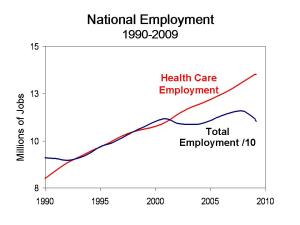
Despite the lack of overall job growth during the last decade, health care employment grew by 2,800,000 jobs, as it did the previous decade. The shocking fact is that, if health care employment hadn’t increased to this degree, today’s unemployment rate would be 10.5% rather than 8.5%.
Economists expect job growth to resume as the economy recovers. But which jobs will grow? Certainly not manufacturing. And not financial services. Many states are looking to health care for these jobs. They see health care as their economic engines.
If health care expands to the same degree over the next decade as it did during each of the past two, how many more physicians should be expected? Historic trends suggest that growth of this magnitude should be accompanied be an additional 250,000 physicians, but our educational and training system will provide fewer than 100,000 of these.
If, as many believe, health care spending is sinking the economy, wouldn’t slowing the production of physicians be good? Or is health care an economic engine, as the jobs data indicate. The best answer is that It holds the potential for both, so finding the point of balance is important. It’s simply hard to imagine any appreciable growth in health care without the physicians who are at its epicenter. So the next time you hear that we should expand access, increase quality and cut spending, reflect on what cutting spending means, not only for quality and access but for jobs.
Nevada’s Tragic Health Care Reality
Some folks from Nevada asked me why the Dartmouth group says that their state has excess expenditures when it doesn’t feel that way. In fact, it’s so bad that 60 Minutes did a special about it on April 5th. So I took a look at it, and here is what I found. There are two Nevadas, the Dartmouth group’s and the real one.
According to Dartmouth logic, Nevada ranks
#16 from the top for Medicare per enrollee (high spending)
#2 from the top for specialists per capita (among the most)
#35 for Quality (near the bottom third)
#44 for Mammography among Medicare beneficiaries (near the bottom)
The Dartmouth group would conclude that Medicare spending is high because Nevada has too many specialists who use too many “supply sensitive services,” yet outcomes (quality, mammography rates) are poor. The solution would be to create practice incentives so that those surplus specialists in Nevada would stop churning the system and give good care for less, instead.
But in reality, although Nevada rank #16 for Medicare spending, it ranks
#43 for specialists per capita (among the fewest in the nation, not the most)
#43 for total spending per capita (among the lowest spending in the nation)
#50 for health care workers per capita (the fewest in the nation)
#44 for Mammography among Medicare beneficiaries (very low)
#38 for Mammography among women 40-65 (also very low)
Everything except Medicare spending ranks low—low physician supply, few health care workers, low total spending and poor outcomes. Outcomes, such as quality rankings and mammography rates, depend on total revenues (Medicare plus everything else), not just Medicare. The strongest correlate of mammography screening among Medicare patients is the rate of mammography screening younger women in the same community. Mark Pauly calls this “spillover” If efforts are made to reduce the number of specialists and reduce the amount of Medicare (and other) spending through practice incentives, Nevada’s health care will crumble.
Mistaken Notions about Health Care Reform from McKinsey and Dartmouth
In his article on health care reform in the April 2nd New England Journal of Medicine, John Iglehart said: “Seemingly to a person, they (the Obama team) share Orszag’s belief that, given the competitive environment created by globalization and the lack of evidence that spending more on health care necessarily results in higher-quality care, we must put a stop to the pattern of health care expenditures’ growing far more rapidly than wages and the overall economy. A recent study by the McKinsey Global Institute estimated that the United States spends $643 billion more every year on health care than its peer industrialized countries, after adjustment for wealth.” Both notions need careful re-examination.
NOTION #1 More spending does not “necessarily” result in higher-quality. (No, it actually does!)
This statement is straight from two Annals of Internal Medicine papers about regional variation in health care (“necessarily” is the catch word, inserted by the editors). It divided the nation into five quintiles. Nothing was “necessarily” better, nor was anything necessarily worse among the five, because although hospital regions were collected into each quintile based on their levels of Medicare spending (so that was similar), these regions were dissimilar for total spending and everything else. As a result, the average values in each quintile were “average,” and nothing was necessarily better. Yet, as I reported in Health Affairs in December, a positive relationship between TOTAL health care spending and quality is readily observed among states.
It’s clear from the comparative studies that health care is better in parts of the US where spending is greater. Nonetheless, the idea that “more is less,” or at least “not necessarily more,” is fixed in the minds of policy makers.
NOTION #2 Relative to GDP, US spending exceeds the OECD trend by $634B because of volume of service. (No, it’s price!)
In a draft of our 2003 Health Services Research paper, which was later shortened so it wasn’t in the final, Tom Getzen and I said: “Rather than resulting from excessive numbers of personnel, it appears that the greater health care spending in the U.S. is a function of higher prices and wages.” (The supporting data are still in the paper.)
A decade earlier, Mark Pauly showed that, when labor costs in OECD countries were adjusted to US wages and these were compared with GDP, health care spending was actually lower in the US relative to GDP than in many other countries. He summed it up by saying, “When politicians and policymakers ask, ‘How does Germany (or Canada or the United Kingdom) do it?’ a large part of the explanation for a lower GNP share is that they pay health professionals less.”
Gerry Anderson drove this point home in his 2003 paper, “It’s The Prices, Stupid: Higher health spending but lower use of health services adds up to much higher prices in the United States than in any other OECD country.”
Why McKinsey Global failed to be aware of the important relationships between expenditures, volume-of-service and prices is a mystery, but it feeds the false notion that the higher spending in the US is due to an excessive volume of service, while it is predominantly higher prices.
Both of these notions are prominent within the rhetoric of health care reform, and both will have to be better understood if the health care reform that unfolds is to be coherent and workable.
Of Bananas and Heaven: The Best and the Best
Peter Orszag quoted Uwe Reinhardt, the renowned Princeton economist, who asked: “How can it be that the best medical care in the world costs twice as much as the best medical care in the world?” (see “Helping Orszag Get It Right”)
The answer from Mark Pauly, equally renowned Penn economist, is: “Growing the best bananas is in the world in North Dakota would cost twice as much as growing the best bananas in the world in Puerto Rico (both in the US). It costs more to raise healthy people in hostile climates, like poverty, social dysfunction, racism and low education.”
And Greg Scanlon, of The Heartland Institute, answered by recalling Jack Wennberg’s observation that women in Lewiston, Maine were much more likely than women in nearby Wiscassett to have a hysterectomy. “Of course, the thing Jack didn’t understand is that Lewiston is heavily French Canadian and Catholic, while Wiscassett is almost entirely Protestant. The ladies of Lewiston were using hysterectomies as a form of birth control that was acceptable to the Church. Researchers often ignore cultural differences when making assessments like these. Is it really so awful that, after having six or eight kids, a woman might want to stop without risking eternal damnation?
Less is Less — Mississippi
It’s sometimes complicated to explain why published data are incorrectly interpreted. This short post and the short paper that it was taken from use Mississippi as a case in point.
Does Mississippi really have more specialists and does it spend more on health care than almost every other state, as Baicker and Chandra claim? Can Mississippi, which ranks near the bottom in health care quality, lift its status by improving its health care productivity, as their Dartmouth colleagues suggest? If these questions gnaw at you, as they did at me, there’s a need to probe further.
It turns out that Mississippi doesn’t really have an abundance of specialists. What Mississippi actually has is a high score in a statistical exercise used by the Dartmouth group. But for Mississippians, it’s not a game. Mississippi has the fewest specialists per capita in the Nation. Mississippians have less and they get less.
And it turns out that Mississippi doesn’t spend more on health care. As is characteristic of analyses by the Dartmouth group, the metric was Medicare, which is not a proxy for spending overall. As in many poorer states in the south and southwest, Medicare reimbursement in Mississippi is high, but reimbursement from other sources is low. It’s no surprise that such states have trouble sustaining better quality. Less leads to less.
The reality is that health care quality is better where there are more physicians (both generalists and specialists) and where communities make greater investments in health care. There are limits to how much more Mississippi or the nation as a whole can afford, but be assured — more is more, and that makes the policy choices even harder.
 Buz Cooper MD