Let’s Talk About Poverty
Did you know that the poorest 15% of our fellow citizens consume more than twice as much health care as the richest? That means that if health care spending for everyone could be the same as it is for individuals at the median, our nation would consume 20% less health care. That’s a sobering reality.
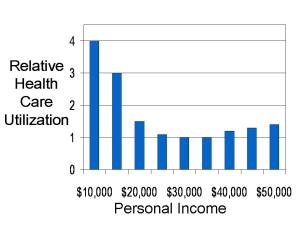
These extra costs are partially due to more emergency room visits, but they are mainly due to more doctor visits and more hospital admissions and more readmissions and longer lengths of stay and more in-hospital deaths, because poverty and illness go hand in hand, and outcomes are poor among the poorest, and coping with illness is far more difficult when you’re poor, especially if you lack a support system and education and language proficiency.
Poverty actually accounts for most of the regional differences in health care spending that have captured the attention of policy-makers and that I have commented upon elsewhere in this Blog. But the connection between regional variation and poverty is rarely made.
Solving this problem will not be easy. Part of the solution is in wider use of tools that are known to decrease these costs among poor individuals, such as interpreters and home health aids and other strategies that strengthen the local infrastructure that enables health care. Of course, durable solutions require attention to the underlying disease – poverty – and that’s the biggest challenge. But the stakes are high and the value is broad, not only for health care but for the lives of those who will otherwise be poor. Dealing with the high health care costs of poverty should be the top priority of 21st Century health care reform.
 Buz Cooper MD
2 comments